Description

Peace Corps Service: March 2012 - May 2014

Monday, September 17, 2012

Girls' Education in Senegal

So I've been in Senegal for 6 months already, and I'm sure many of you are wondering when I'm going to start some "real work." Projects tend to be rather long-winded in the development realm, primarily because we have to deal with the bureaucracy of the grant process, after you've finally come up with a feasible and sustainable project. However, one project that I'm lucky enough to already be a part of (because it is a collaborative effort of all volunteers in our region) is the Matam's 2nd Annual Girls' Leadership Camp. I recently finished up the Michelle Sylvester Scholarship at the middle school near my village, which involved working with the top 9 girls from 3 different grades at this school to pick 3 winners of a grand prize scholarship to go towards school supplies and tuition. Most PCV's participate in this scholarship program, and to continue working with these distinguished young girls from each of our schools, we've organized a leadership camp for them and to reinforce the benefits of education. It's an excellent program, especially in our region where you see girls married off as early as age 11 and many times cooking and cleaning their family's house before this age if they're not married. Education is not a priority in many girls' lives, and I hope that by positively influencing even a handful of girls to continue with their education we make strides in the right direction. School is an opportunity to gain critical thinking skills, socialize with people of their own age, and overall gain a type of independence. The leadership camp reinforces positive mind-sets among girls and encourages them to stay in school.

In general, the schools in my area are pretty well funded and taught. There just needs to be further encouragement to ensure every child has the motivation to stay in school, despite the social pressures to marry early.

We cannot complete this project without your help. We're fundraising to have this camp through a Peace Corps Partnership Grant and anything you can spare will make sure these girls have an opportunity for creativity, leadership, and a general outlet that they may not get in their daily lives.
Go here to donate:
https://donate.peacecorps.gov/index.cfm?shell=donate.contribute.projDetail&projdesc=685-221


More updates how this camp goes early next year, but thanks for your support!


I'll leave you now with a video of some of these girls performing a traditional Pulaar dance at the end of the school year celebration:


Saturday, September 15, 2012

IST and Ourossogui Eye Clinic

I've just finished a whirlwind month of work, all of which took place out of site, so it's been quite a change of pace from my slow month of Ramadan. I caught a Peace Corps ride down to Dakar about a month ago, an air conditioned land rover was a nice alternative to a cramped and stuffy public transport car. [Side bar on public transport here: it is miserable even in the most "luxurious" of forms. A 7 seater (sept-place in French) car (a station wagon with a third row) is the nicest/fastest way to get anywhere, but 12 hours in a cramped car is still less than pleasant. And there is no schedule. Cars leave when they are full so you can spend anywhere from no time to 5 hours waiting for a car to leave once you've gotten there and bought your ticket.. (Though to be fair it's mostly the 14 seater vans or big (50ish people) buses that you're waiting 2+ hours for.)]

After a few days relaxing and exploring Dakar I went to the Thies Training Center again, this time for our In-Service Training (IST) where I reconnected with my fellow stagiers and got inspired for potential projects I could do in my site. It was crazy to be back at the training center, but very cool to check in with everyone and see how different our various experiences already were. We had 10 days of sessions on gardening, maternal and child health, sanitation, and various other types of projects volunteers in sector have done.

After that I came straight back to Ourossogui to participate in an Eye Clinic another volunteer in the area organized. The trip back ended up taking 2 days, due to some misplaced trust in the buses. We caught an early morning bus outside of Thies which was supposed to take us all the way to Ourossogui (a 12 hour direct ride, though we knew it'd be longer with the inevitable stops). After a few too many stops and transfers, we decided to get out in Ndioum where the northern regional house is, as it was already 6:30 and a midnight arrival in Ourossogui (especially on the horrible roads for the last 200km) was less than desirable.

At the eye clinic we worked for 2 weeks at the hospital with a team of American doctors from an NGO and performed 140 cataract surgeries during this time. My role varied throughout the 2 weeks as we had 2 different groups of people for the 2 weeks. The first week I stayed primarily in the pre-op room, conducting vision exams in Pulaar, and prepping the patients by giving anything from eyedrops to information. The second week I worked with the post-ops, as well as giving out reading glasses (as the NGO brought boxes of those as well). It was overall an incredibly interesting experience. There were definitely parts that made me anxious (taking patients without knowing their medical history, sometimes not being sure if the patient really knew 100% of what the surgery entailed--I definitely had a few older women turn to me after I put in their dilating eye drops if they were done and could go home...) but overall, seeing some people come out with markedly improved vision was incredibly rewarding. I've also realized I am not cut out for the medical profession, just seeing the anesthesia injection into the eye area made me incredibly queasy. I can't even begin to imagine how scared some of the patients were (it was many's first time receiving this type of medical care) and I can only hope my limited Pulaar was able to ease some of their minds.

Busy OR

One of the cataracts

Group of happy post-ops


I will soon head back to village after a month away and I'm excited to get back to that part of my Peace Corps life.. I've missed my host family, friends, and even the village food!

Monday, August 13, 2012

Ramadan

It is currently the 3rd week of Ramadan, the Muslim month of fasting (meaning no food or water for all daylight hours, essentially from 5:30 am to 7:30 pm). As my entire village is Muslim, you can imagine the dramatic change in pace of life that has occurred over the past few weeks... It has come to a bit of a standstill.
In the states I only knew a handfull of people who participate in Ramadan, and it never had such an impact on my life as it does now. It's definitely an interesting experience. While I'm sure fasting as a community makes it easier to complete, it also comes with some complications-- community image of devotion, or merely the ease of completing the difficult month with the support of your fellow fasters (especially if you're the female who cooks in the house... nobody wants to be cooking for the house while they are making up their fasting days beyond Ramadan). Fasting is quite difficult (especially with the 100 + degree F heat we've been having) and many people power through and fast during all of Ramadan with the community (rather than skip a day for legitimate reasons and make it up later throughout the year by themselves)... this includes many pregnant women and older folks. While I understand that this is a religious practice, and I honor and respect that, it's hard to see people who need to put their health first and not do so. One of my older host-moms already had to go get an IV drip at the health post, and many women in their 3rd trimester of pregnancy are still fasting. As a health/environmental ed volunteer, I'm still trying to figure out how to address these situations in a culturally acceptable manner. This year Ramadan also falls during the short but sweet rainy season, so people are still going out to the fields to work in the morning, but luckily this means we're getting some cooler days as well.
Volunteers choose different ways to adapt to this month long change of pace, some try fasting as well, some sneak food in their huts (I am of this variety) and some just choose this time to go on vacation. I did one day of solidarity fasting (and essentially slept all day), and am currently subsisting on peanut butter oatmeal, mangoes, and Mauritanian biscuits (I may dedicate a blog post to these at a later date, they are amazing- I can't explain why because they are just bland biscuits... but I'm addicted). 
Luckily I haven't started any time pressing projects yet, because the day gets progressively more sedentary, and many people aren't willing to do much more than the absolute necessities. As my job is still mostly getting to know the village and integrating, Ramadan has actually been a nice time to go greet and visit the various compounds in my village-- people are always home and nobody is trying to shove food at you the entire time you're there (sure, not eating at all isn't ideal, but sometimes overly-hospitable households just seem impossible to please... "you didn't eat anything!").

In other events, I went to Dakar for an impulsive trip to see Hillary Clinton address US Embassy/Foreign Service employees. It was a short but sweet presentation, but the real reward was all the delicious food and first world amenities I was able to indulge in while there. Burgers, ice cream and a shopping mall have never been such an amazing experience. 

Monday, July 9, 2012

Kedougou- the land of waterfalls

I just spent a few days in the south of the country, the Kedougou region of Senegal. Volunteers from all over Senegal convene there for the annual 4th of July party at the Kedougou house, and I took this time to explore the area as well. Ecologically, it's a whole different world down there. Whereas I'm in the desert, Kedougou is the tropics. I've definitely developed some envy for the volunteers serving in this region (they live in huts! there's vegetation!), but I also came back with 50+ mosquito bites (something I haven't had to deal with), so I'm realizing there's a pro and con for every living situation. So I soaked in the greenery, avocados and waterfalls while I was there, but I'm honestly pretty happy to return to the dry heat of my desert.


Top of the fall in Segou


Jungle-looking hike to Segou falls

Walking from Segou to Dindefelo

Dindefelo waterfall

Gorgeous views all around the fall in Dindefelo


Saturday, June 16, 2012

Senegalese hospitality

My first month of village has passed surprisingly quick. I'm slowly adapting to life here, and more importantly becoming increasingly comfortable with my family and community. I'm still at a loss as to what my "job" here is at times, I've definitely felt rather ill equipped with my limited communication skills as of late (especially at the middle school where I'm organizing a scholarship, and most teachers speak French) which don't exactly let me show any type of other skills I may be able to offer. But I think that's the point, I have 2 years here for a reason. First I meet and learn, then I do some good work. So I've focused on meeting people in my village and the villages around me. Senegalese are very hospitable and the extent of it is downright amusing; I've already taken a mid-day nap at a women's house the very day I met her.
Foundational knowledge: when you visit a Senegalese person, you spend the day (if not many) with them.
Backstory to my napping experience: I head to the village over from mine (about 2 km away) to buy some phone credit. I go to their market to greet (always great extra language practice), and one woman says I have to go meet someone named Sohna. She mentions something about a garden, so I figure this has potential work involved and follow. She takes me to, who turns out to be, the president of the women's group in the village. After chatting for a bit, we head to see the women's garden (where she gives me fist-fulls of mint that is currently growing there). We go back to her place and after chatting for a bit I tell her I'll head home. She looks appalled and says no way, it's too hot. I have to stay, eat lunch, rest and then head home. I agreed, it was mid-day, around 110 degrees, and even the short 2km seemed like an unpleasant idea. After lunch (fish and rice, the usual), and a delicious iced sour milk and sugar refreshment, it was still rather warm out, so she told me to lay down and rest (hence naptime!). After a few rounds of tea, presents of fabric and hand-spun cotton, it was late afternoon and could finally make the journey back to my village (though not straight back.. we stopped at another house for a round of orange soda). This is an example of typical hospitality here, especially when in a slightly wealthier village like the one near mine.


My set up in village is pretty sweet- I've got my own free standing room in a family compound.
My room. Note the proximity to the mosque. 5:30am call to prayer is so much fun!

The bed I sleep on at night (outside) is the home of many activities during the day.. yeah, where that girl is washing dishes is where I sleep.

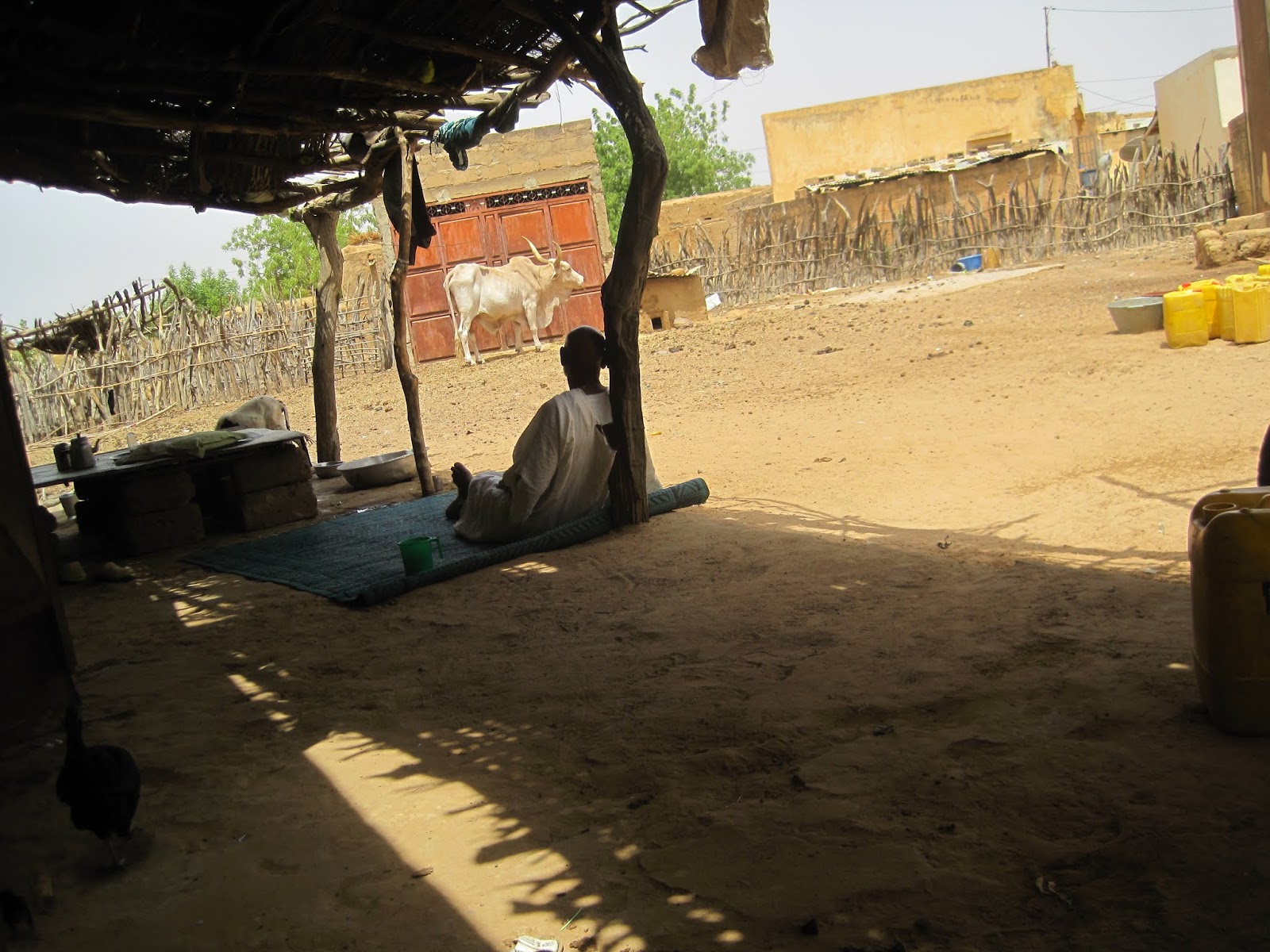
The view from my room. Cows are a common sight.

My host dad, the village chief. He spends most of his days sleeping.


Monday, June 4, 2012

Village life


I’ve skipped out to Ourossogui for the day to catch up with some fellow volunteers and get out of village for a bit; 2 weeks spent mostly within a 3 km radius can leave one a little stir-crazy. 

My install at village, where appropriately Shakira's "Waka waka- This time for Africa" was playing as I rolled into site, was relatively anti-climactic but a warm welcome from the villagers nonetheless. Village life is completely different to the life I got used to during training. It is a hundred-fold slower paced and I have no set daily activities. My current “job” is going and meeting the village, with limited Pulaar skills, while improving these Pulaar skills. As I am already on the shyer side when it comes to meeting new people, and I’m not necessarily the chattiest in these situations when I am to speak English, you can see how this has been mildly anxiety-inducing for me. Luckily I’m paired with 2 counterparts through Peace Corps, my community counterpart is the president of the women’s group in my village, and my technical counterpart is the school director of the college (middle school-ish grades). So when all else fails, I just go greet them and see who else I may meet there/on the way. The hardest part is remembering people’s names, especially when I meet them randomly, but I'm getting better at it. 
My village is an interesting work environment because it is relatively big, about 2,500 people, and because NGO’s have been very active in the area for at least 10 years. As the north is the most conservative part of Senegal, one NGO has been working on women’s empowerment projects such as female literacy classes in the local language, organizing women’s groups, etc. It makes my work here both more and less clear. I could pursue the direction of simply blending into this structure and working within these finely created development schemes. However, it’s hard to tell to what point these projects have affected what the people feel they need-- the men have already approached me for a men’s Pulaar literacy class. While I have taken to going to the literacy classes (though I am the only one there with the problem of being able to read the language, but not know what it means) to have a different way of practicing and to get my face known among the women, I can’t help to question the efficacy of teaching Pulaar literacy. It primarily is, and once only was, a spoken language. While I appreciate that it has been written down because that means I was able to study it the way I’ve studied all my subjects in the Western world, I can’t help but wonder to what end are these women learning to read Pulaar? My idealistic side and pragmatic side are dueling out this thought. 

I’ve also survived my first sandstorm. It was a bit of a shock. I was sleeping outside (which I do every night, my room is far too hot to sleep in this time of year) and all of a sudden a huge wind hits and my mosquito net flies off. I look around and everyone else in my compound is grabbing their nets and mattresses and scurrying inside, so I follow suit. Between my pillow, sheets, flashlight, keys and mattress I need to make 2 trips,  so I run against the wall of sand pushing towards me with everything except my mattress to my room. By the time I make back to my mattress it has been blown vertical, luckily stopped by the posts holding up the shade structure I sleep under. I got away with only eyes full of sand, and a great story to repeat to the villagers the next day-- my first sandstorm, they loved it. 


People love talking about me in my village, especially when I do something seemingly bizarre, like running in the mornings. I think it’s hilarious, and my perspective is this: if they are smiling when talking about me, that’s as close as they can get to liking me because my language is no where near where I’d need to to charm them by words. And it gives us one more thing to talk about. “You went running?” “Yes I went early this morning! Did you see me?” “No, but I heard from so and so you went..” and so on.. (Also: everyone in village will find out about anything I’ve done. After I went on my first bike ride, everyone was asking me where I went that day, despite the fact I only pass a few compounds to get to the road.)  So I sit, I smile, I laugh, I say my few words in Pulaar, I attempt to dance Youzza or Cahalgum, go about my “strange” routines and hope for the best. 

Monday, May 14, 2012

Start of real service

Finally made it up to my permanent area, and installing in my site on Thursday! I took a sept place (seven seater station wagon) up to Ourossogui yesterday with the other volunteer installing near me and all of our possessions. We're picking up all of our necessary living items over the next few days (mattresses, buckets, cups, etc) and just mentally preparing for the transition to village life. Training has been such a different experience to what service will be, and only now am I starting my real life here in Senegal.

The last few weeks of training have been full of fun adventures so I'll give you a quick recap:

Dakar Day: Part of training is taking us to the PC office in Dakar and having a catered lunch from the embassy. We were treated to fried chicken, hummus, and by special request several platters of guacamole. We also went to N'Ice Cream, quite possibly my new favorite place in Dakar (note: they had a flavor "Obama").

Popenguine: a lovely beach location south of Thies. In PC trainee tradition we rented out 2 beach houses and headed for some fun and sun. I can definitely say I will be returning.


The coastline at Popenguine and one of our houses for the night.


Swearing-in at the Ambassador's house: To become an official PCV you have to take an oath to defend the constitution and we dress up in fancy Senegalese attire and go to the Ambassador's gorgeous house to do so. A quick ceremony, a few speeches by fellow trainees in the local languages (everyone who spoke did amazing! youtube links soon) and some kind words from our staff were followed by an amazing array of hor d'oeuvres, including quiches and mini-pizzas followed by brownies and fruit tarts. After 9 weeks of primarily fish and rice and cous-cous, we were vultures.

After swear in we had a few free days at the center to pack and hang out, indulge in the amenities and available foods in Thies, and now we've all dispersed to our respective regions.

I may participate in the "5 week challenge"where I don't leave site for 5 weeks after install, so my internet connectivity may be quite limited over the next month or so.. wish me luck!