Peace Corps Senegal recently released an excellent video about the day in the life of a student from a village in the Kaolack region of Senegal. While there are a few differences between the video and my village, it is a very good representation of what life is like here for kids. Take a look!
Monday, June 24, 2013

Tuesday, May 28, 2013
So, what do you eat?
I have to say, it's one of the most common questions, yet I have failed to address it in this blog! So here it is, my food post.
In a lot of ways, it's simple. I eat the same things most days..
For lunch it's a community bowl, usually rice with one fish (fried, stuffed with pepper and spices) and veggies (seasonal; currently we've been getting eggplant, potato, cabbage, and squash). Other lunch dishes are rice with a peanut sauce with okra; or, a millet, bean and fish mush with oil (a lot better than it sounds I promise, though my family rarely makes it).
For dinner it's a dish called haako (the dish has the same name as 'leaves'.. because that's what it is, leaf sauce!). It's made with bean leaves, peanuts, and fish all ground together poured over cornmeal 'cous-cous' called lecciri (pronouced: leh-chee-ree). I put 'cous-cous' in quotes because it's a lot grainier than the cous-cous you can buy in the states. Another dinner dish is called bassi which is this onion soup-esk dish with peanut butter and tomato sauce poured over lecciri. On other nights we have lecciri and fresh or reconstituted milk. My house most often eats the haako, but these are the 3 staples.
I've saved breakfast for last because I eat that on my own, and therefore it varies. My family eats plain bread and coffee (though I argue to call it hot sugar water) so I chose to eat breakfast on my own. Sometimes I still buy bread and peanut butter, but more often I eat oatmeal, or a Clif bar, or if I've saved some lecciri from dinner the night before I'll make that with milk.
Otherwise, there's a lot of snacks as well. My good friend Ndiabel loves to feed me other than mealtimes, this last week alone she cooked a few meal/snacks: sweet potato tomato onion sauce, bean sauce, and fish and fries with onion sauce (as you can tell, the same ingredients are recycled in many manners). Also, buying snacks on the street is easy enough, and range from tiny bags of roasted peanuts, frozen juice in bags (creme glace/"ice cream"), roasted corn (seasonal) to deep fried goodies such as beignets (donut holes) or fatayas (dough stuffed with onion sauces, sometimes fish). This is not including your usual selection at the corner shop: biscuits, cookies, cheese puffs (which are hilariously called Crax) and others of the "junk food" variety.
Though of all this great selection, my favorite snack has to be Vache Qui Rit (Laughing Cow cheese) with Mauritanian biscuits, occasionally with dried fruit if the care-package gods have blessed me. I have appeased my foodie side by convincing myself that Vache Qui Rit is something like Brie...

The best for last being.. frozen kossam! (Kossam is sour milk, or essentially yogurt... meaning frozen yogurt.) Often sold in quarter liter bags, it makes those 115 degree days bearable and delicious. Slice up one of those huge mangoes that are now in season and sold on the streets, and I think it almost puts any froyo shop in CA to shame.

In a lot of ways, it's simple. I eat the same things most days..
For lunch it's a community bowl, usually rice with one fish (fried, stuffed with pepper and spices) and veggies (seasonal; currently we've been getting eggplant, potato, cabbage, and squash). Other lunch dishes are rice with a peanut sauce with okra; or, a millet, bean and fish mush with oil (a lot better than it sounds I promise, though my family rarely makes it).
 |
| A bowl of the more meager variety, no fresh fish, but rice and veggies, dried fish and beans |
For dinner it's a dish called haako (the dish has the same name as 'leaves'.. because that's what it is, leaf sauce!). It's made with bean leaves, peanuts, and fish all ground together poured over cornmeal 'cous-cous' called lecciri (pronouced: leh-chee-ree). I put 'cous-cous' in quotes because it's a lot grainier than the cous-cous you can buy in the states. Another dinner dish is called bassi which is this onion soup-esk dish with peanut butter and tomato sauce poured over lecciri. On other nights we have lecciri and fresh or reconstituted milk. My house most often eats the haako, but these are the 3 staples.
 |
| Haako (with beans!) and corn lecciri |
I've saved breakfast for last because I eat that on my own, and therefore it varies. My family eats plain bread and coffee (though I argue to call it hot sugar water) so I chose to eat breakfast on my own. Sometimes I still buy bread and peanut butter, but more often I eat oatmeal, or a Clif bar, or if I've saved some lecciri from dinner the night before I'll make that with milk.
Otherwise, there's a lot of snacks as well. My good friend Ndiabel loves to feed me other than mealtimes, this last week alone she cooked a few meal/snacks: sweet potato tomato onion sauce, bean sauce, and fish and fries with onion sauce (as you can tell, the same ingredients are recycled in many manners). Also, buying snacks on the street is easy enough, and range from tiny bags of roasted peanuts, frozen juice in bags (creme glace/"ice cream"), roasted corn (seasonal) to deep fried goodies such as beignets (donut holes) or fatayas (dough stuffed with onion sauces, sometimes fish). This is not including your usual selection at the corner shop: biscuits, cookies, cheese puffs (which are hilariously called Crax) and others of the "junk food" variety.
Though of all this great selection, my favorite snack has to be Vache Qui Rit (Laughing Cow cheese) with Mauritanian biscuits, occasionally with dried fruit if the care-package gods have blessed me. I have appeased my foodie side by convincing myself that Vache Qui Rit is something like Brie...


Saturday, May 4, 2013
Moringa, the Miracle Tree!
Throughout training as Env/Health volunteers we were fed a few key buzz-word projects that are our go-to work in all communities of Senegal. Among the maternal and child health, malaria work or general health infrastructure sessions we learned about the Moringa tree, also known as a "miracle tree" in the developing world due to its many nutritional properties and uses. They really sold it to us: It's full of vitamins and nutrients and is fairly easy to add to the diet: people can eat the leaves, either in leaf sauce or by drying it to make powder that you can put in any dish. Besides it's incredible nutritional composition, we could use the tree for everything! Live fencing; wind-breaks; alley-cropping... Lesson was: plant moringa, it's good for the soil and the people! Don't believe such an amazing tree exists? Read the wiki on Moringa for further info.
At first I was quite skeptical.. how can this one tree be so magical? Upon tasting the fresh leaves-- peppery, almost arugula-like--I started to cave.. I can get on board with a substitute for my favorite salad base. Then (being academically trained in human-environment interactions) I thought about the consequences of planting moringa everywhere.. Is it local? No, it's native to Northern India. Additionally, it's a drought-resistant species that is actually called "Nebedai" in local languages because the British colonists in The Gambia called it "Never die".. sounds like a possibly invasive species. So I remained uncertain about the seemingly wonderful tree.
But as I've been living in the desert for the past year I've realized one thing... I live in a sandy wasteland. There are very very few trees, and the only ones that are around usually have thorns. I've come to the conclusion, that in the Sahel, any living tree is better than no tree. And given it's drought-resistant qualities, it seems like a tree that can hack it in the Sahel. So I've started planting Moringa. Why not? Most people are willing to eat it; we already eat leaf sauce for dinner every night, but it's currently being made out of the more readily available bean leaves. And even we do nothing with these trees but keep them alive, that will be an environmental improvement in and of itself... things will actually look green.
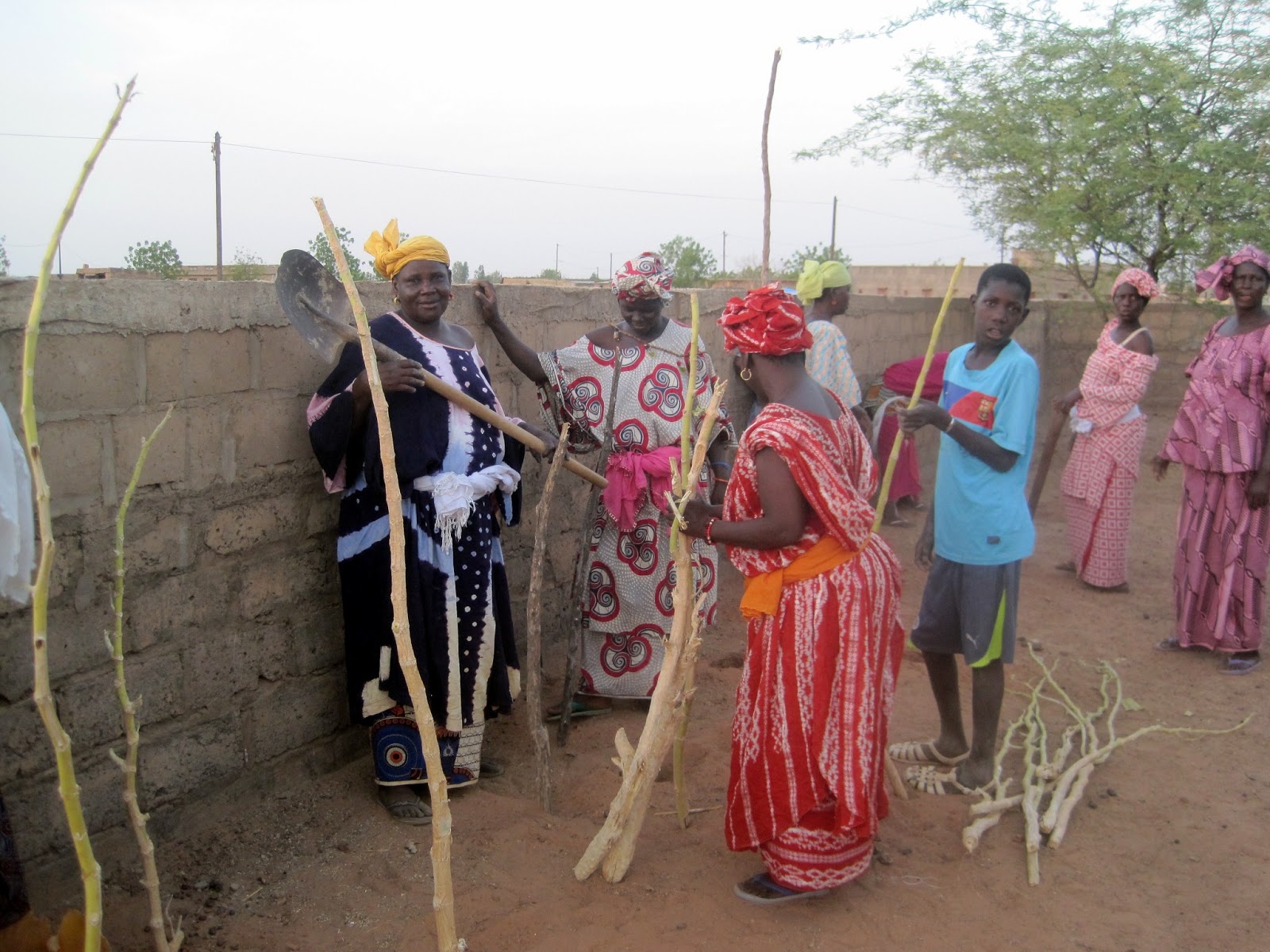
I've started at my village's primary school. Working with the mothers of primary school children, the children themselves and any one else around to help, I've direct-seeded Moringa around the perimeter of the school. So far we've planted about 25 trees (all were sprouted and alive when I left village a few days ago... keeping my fingers crossed that they're still getting watered without my watchful presence in village..). As people see and get excited about these initial sproutlings, we will continue around the rest of the school, hopefully planting up to 100+ trees. I'll keep you posted on how this works out, but here's the progress so far:

At first I was quite skeptical.. how can this one tree be so magical? Upon tasting the fresh leaves-- peppery, almost arugula-like--I started to cave.. I can get on board with a substitute for my favorite salad base. Then (being academically trained in human-environment interactions) I thought about the consequences of planting moringa everywhere.. Is it local? No, it's native to Northern India. Additionally, it's a drought-resistant species that is actually called "Nebedai" in local languages because the British colonists in The Gambia called it "Never die".. sounds like a possibly invasive species. So I remained uncertain about the seemingly wonderful tree.
But as I've been living in the desert for the past year I've realized one thing... I live in a sandy wasteland. There are very very few trees, and the only ones that are around usually have thorns. I've come to the conclusion, that in the Sahel, any living tree is better than no tree. And given it's drought-resistant qualities, it seems like a tree that can hack it in the Sahel. So I've started planting Moringa. Why not? Most people are willing to eat it; we already eat leaf sauce for dinner every night, but it's currently being made out of the more readily available bean leaves. And even we do nothing with these trees but keep them alive, that will be an environmental improvement in and of itself... things will actually look green.
I've started at my village's primary school. Working with the mothers of primary school children, the children themselves and any one else around to help, I've direct-seeded Moringa around the perimeter of the school. So far we've planted about 25 trees (all were sprouted and alive when I left village a few days ago... keeping my fingers crossed that they're still getting watered without my watchful presence in village..). As people see and get excited about these initial sproutlings, we will continue around the rest of the school, hopefully planting up to 100+ trees. I'll keep you posted on how this works out, but here's the progress so far:
 |
| Rice sack tree protectors. Necessary for high goat traffic. |
 |
| Digging the protectors |

 |
| And they've sprouted! |
 |
| Hello, Moringa! |
Sunday, April 7, 2013
Who run the world? Girls!
Matam Girls Leadership Camp: 5 days, 10 PCVs, 28 middle school (ish) girls (ranging from ages 11 to 17) coming from 8 villages.
We started the camp with ice breakers and teaching the girls a dance to Beyonce's 'Who Run The World (Girls)', which we used as our theme for the camp (Pulaar translation: Mo laami aduna? Rewbe!).
The next day we jumped into sessions, asking girls to reflect on their lives (current stresses, future dreams) and then playing "The Best Game" which teaches the girls about entrepreneurship and money management.
We included sports sessions each afternoon.


That evening we had the girls make collages representing their present and futures lives.
The next day we had a nurse midwife come talk to the girls about reproductive health and diseases, topics that are rarely addressed in these conservative communities. We followed that with a session on women's rights from a guest speaker from the local NGO Tostan. We wrapped up the day with a light-hearted session on American Culture, clearing up the stereotypes that circulate about us Americans, and giving them an insight to our culture and lives.
During our sports session that afternoon we did a dance exchange, where we taught some American dance moves (Single Ladies, Dougie) and they taught us some Senegalese moves. When our speakers couldn't play their Senegalese Mbalax music loud enough, the activity quickly turned into a drum circle, with girls banging on pans and water jugs as various individuals showed off their moves in the center of the circle. They even pulled each of us volunteers into the middle to show what we've got.


On Sunday we had some more sessions, the first on leadership, followed by a session on gender roles and the stereotypes attached to them. It was great to see the girls openly debate some topics about gender that are rarely discussed.
We then had a group of accomplished Senegalese female professionals from the area come talk to the girls on our career panel. The girls enjoyed seeing the types of careers that are entirely within their reach.
The last day, we had some wrap-up sessions and the parents came to pick up the girls. We had the girls sit down with their parents to talk about their goals for the future, and the steps they would need to take to achieve those goals. This was a very powerful activity, as some girls were meant to get married in the near future (at the age of 14 or so) and came forward to their parents about their desires for their future. While some parents were at first on the defensive, between the girls knowledgable presentation and the helpful assistance of a Senegalese Peace Corps staff member who came to help the camp, they seemed to leave understanding the girls wishes and goals.
We finished the camp off with a cheesy certificate ceremony, which the girls loved.
 |
| My girls: Ndiabel, Ndiabou, Me and Oumou |
We started the camp with ice breakers and teaching the girls a dance to Beyonce's 'Who Run The World (Girls)', which we used as our theme for the camp (Pulaar translation: Mo laami aduna? Rewbe!).
The next day we jumped into sessions, asking girls to reflect on their lives (current stresses, future dreams) and then playing "The Best Game" which teaches the girls about entrepreneurship and money management.
 |
| The girls drawing out what their current life looks like. |
 |
| Handing out 'money' during The Best Game. |
 |
| Discussing financial choices during The Best Game. |
We included sports sessions each afternoon.


That evening we had the girls make collages representing their present and futures lives.
 |
| One of my girls, Ndiabel, presenting her collage. |
 |
| Our midwife only spoke French, so we had a volunteer (as well as the older girls) assist with Pulaar translations |
 |
| Apple pies for the American Culture session. None of the girls liked it (we think it was their unfamiliarity with cinnamon) but that left plenty for the volunteers! |
During our sports session that afternoon we did a dance exchange, where we taught some American dance moves (Single Ladies, Dougie) and they taught us some Senegalese moves. When our speakers couldn't play their Senegalese Mbalax music loud enough, the activity quickly turned into a drum circle, with girls banging on pans and water jugs as various individuals showed off their moves in the center of the circle. They even pulled each of us volunteers into the middle to show what we've got.


On Sunday we had some more sessions, the first on leadership, followed by a session on gender roles and the stereotypes attached to them. It was great to see the girls openly debate some topics about gender that are rarely discussed.
 |
| Our regional volunteer support assistant (VSA), Sakhir, leading the gender roles session. |
We then had a group of accomplished Senegalese female professionals from the area come talk to the girls on our career panel. The girls enjoyed seeing the types of careers that are entirely within their reach.
 |
| Career Panel |
The last day, we had some wrap-up sessions and the parents came to pick up the girls. We had the girls sit down with their parents to talk about their goals for the future, and the steps they would need to take to achieve those goals. This was a very powerful activity, as some girls were meant to get married in the near future (at the age of 14 or so) and came forward to their parents about their desires for their future. While some parents were at first on the defensive, between the girls knowledgable presentation and the helpful assistance of a Senegalese Peace Corps staff member who came to help the camp, they seemed to leave understanding the girls wishes and goals.
We finished the camp off with a cheesy certificate ceremony, which the girls loved.
 |
| Me with some of the girls. |
Overall, I'm rating this camp as a success. We had absolutely no problems with the girls, in terms of behavior or enthusiasm. The girls left in tears, some because they finally were able to discuss their futures with their parents, others due to the close friendships formed in the 5 days. The camp really provided a venue for a new type of learning for many of the young ladies, and a place to get away from cultural and societal norms that may be hindering their creative prosperity. It was rewarding to be part of a project where you see some results immediately, but also leave with the expectation of long-term effects.
Thank you so much to all who donated to this camp! We really could not do this without support from home, and I hope all of you consider a donation to the camp we plan to do next year.
Thank you so much to all who donated to this camp! We really could not do this without support from home, and I hope all of you consider a donation to the camp we plan to do next year.
 |
| Matam Girls Leadership Camp 2013 |
Thursday, March 7, 2013
One Year!
Today marks my first full year in Senegal. I arrived early on March 7, 2012, and really had no idea how my life would change (though I knew it would be in a big way...). Here I am one year later, unable to believe so much time has passed, yet able to see that I am a different person than she who stepped off that plane. I am different in terms of my daily life and amenities, the people I spend my days with, and the language I converse in. I have expanded my perspective beyond my imagination, and somehow adapted to this life.
It's been an eye-opening year. Some trials and tribulations, some self-reflection, and a lot of growth. I am excited to see where the next year takes me.
I think I've done enough "reflection" blog entries lately, so I'll keep this one short and sweet... with some more pictures to show exactly how my life over here looks:


It's been an eye-opening year. Some trials and tribulations, some self-reflection, and a lot of growth. I am excited to see where the next year takes me.
I think I've done enough "reflection" blog entries lately, so I'll keep this one short and sweet... with some more pictures to show exactly how my life over here looks:

My room! Which I painted myself.

My clothes storage trunk and mosquito-net covered bed.

My bathroom. Yes, I shower out of a bucket.

My laundry equipment.

Food prep doesn't always happen in a kitchen... And cutting boards are not a thing here.

My "kitchen"...

My water filter.

Raabi, one of my good friends in village, and her 6 month old son (who is 'named' after my dad).
Saturday, January 19, 2013
Keeping busy
The hardest part of being a volunteer is that while you're in village, you're always on the job. There's no 'clocking out', as a volunteer you start a new life as an occupation. It's a very different arrangement to the 9-5 type of jobs I've experienced, but in many ways it's also refreshing. Sitting with friends and talking, learning Pulaar, is my job. Going out to greet various members of my community, maintaining good relationships (I've jokingly referred to this as "maintaining good PR" given that I am the village celebrity..) and hanging out with people (and playing with their babies) is how I spend a huge chunk of my time. That is not to say that I don't do any 'resume-building' activities, we do have to submit quarterly reports of our activities to our boss, though these can range from attending Pulaar literacy classes to collaborating with NGOs to finally starting your big project-- be it a community garden, health hut construction, latrine construction or any other development project you can think of. I've moved on from just learning Pulaar, and have started doing little things around my community.
As an environmental education volunteer, I am placed to work with the schools, and given the past of NGO activity in my village (a lot of money has been thrown around, and my village tends to have certain expectations when it comes to 'development work') the schools are really the most effective place I can do good work. I have done some smaller things both at the primary school in my village, and the middle school in the village next to mine. Additionally, as we are encouraged to collaborate with other volunteers, I have helped a volunteer in my region set up a women's community garden in the village near me (where we will be placing a volunteer this coming May! I am so excited to have another volunteer a mere 2km away from me, currently my closest volunteer is 15km) and as a region we are currently planning the girls' leadership camp which many of you have graciously contributed to! In other words, despite all my 'sitting around' I'm keeping pretty busy..
Here's a world map mural I painted at my middle school:

And some pictures from the tree planting I did at my middle school:


Some kids who helped clear the area for the women's garden:


As an environmental education volunteer, I am placed to work with the schools, and given the past of NGO activity in my village (a lot of money has been thrown around, and my village tends to have certain expectations when it comes to 'development work') the schools are really the most effective place I can do good work. I have done some smaller things both at the primary school in my village, and the middle school in the village next to mine. Additionally, as we are encouraged to collaborate with other volunteers, I have helped a volunteer in my region set up a women's community garden in the village near me (where we will be placing a volunteer this coming May! I am so excited to have another volunteer a mere 2km away from me, currently my closest volunteer is 15km) and as a region we are currently planning the girls' leadership camp which many of you have graciously contributed to! In other words, despite all my 'sitting around' I'm keeping pretty busy..
Here's a world map mural I painted at my middle school:

And some pictures from the tree planting I did at my middle school:


Some kids who helped clear the area for the women's garden:

Don't worry, it's not all work no play! Here's what my birthday "cake" looked like this year! (Beignets, or donut-like fried batter, is the only cake-like treat easily found/made in Senegal.) I made a huge batch at gave them out to friends in village.

I know to many of you at home, the 2 year commitment I made to be here seems crazy. "It's so long!" I often hear. But realistically, to do something more than just a cookie-cutter development project, as PCVs, we need this time. First to adjust, learn and acclimatize; then to research and understand the community and its needs; and finally to design and implement a sustainable, constructive and useful project for our communities. A lot of NGO's throw money at communities or problems, and the long-term effects of this are various, though rarely positive. I enjoy the fact that I get to learn a language, so I can (hopefully) better understand the people, to do something more than just the typical development projects. This is not to say that building a lot of latrines in a community that doesn't have them isn't a good thing either.. but addressing the 'why' and not just the 'how' is very important.
In other words, I'm doing well over here and at this point the 2 years isn't all that daunting. I'm pretty comfortable with my Pulaar, I've made some good friends in village, I'm finding good work partners, and I am starting to figure out what the rest of my service may look like. (Not sure yet, but figuring it out is half the battle!) I'm also already thinking of post-PC life (I can't believe that I already have to!) which is also exciting. Between my mini-projects, my daily learning, and planning for my future both PC and beyond, my 2 year commitment is going by quite quickly so far. I know I still have over a year left, but the way the last 10 months have flown by.. I'll be home in no time!
Friday, January 4, 2013
Back from a holiday whirwhind
I have just returned to my regional apartment after the holidays, during which I did a 430km bike trip. It was an amazing experience, and while prior to leaving I thought what I could really use was some Dakar luxuries (i.e. good food), seeing a new place and connecting with new villages reaffirmed my desire to be in Africa. People were so hospitable and helpful-- from Pulaar women on the road (upon hearing me greet them) saying a few blessing for our journey, to a village taking us in for the night if we were in between hostels on the road. The people truly made our journey both bearable and worthwhile. We saw some amazing new scenery, and while the continuous biking was at times tough, the whole trip was well worth it as we dipped our toes in the Atlantic Ocean on New Years Eve.
And despite the fact I am finally feeling so at home here in Senegal, the holidays inevitably make one think of family, friends and that other home across the ocean. I want to take this time to thank all of my blog readers that came out of the woodwork to send some Christmas greetings in the mail! I was so touched by all the cards.
Dziekuje bardzo za mile swiateczne zycenia! Pozdrawiam wszystkich, i przesylam naj serdeczniejsze pozdrowienia w Nowym Roku!
Also, thank you so much to everyone who supported and donated to our Girls' Camp! We are fully funded and will be able to put on the camp in March.
And despite the fact I am finally feeling so at home here in Senegal, the holidays inevitably make one think of family, friends and that other home across the ocean. I want to take this time to thank all of my blog readers that came out of the woodwork to send some Christmas greetings in the mail! I was so touched by all the cards.
Dziekuje bardzo za mile swiateczne zycenia! Pozdrawiam wszystkich, i przesylam naj serdeczniejsze pozdrowienia w Nowym Roku!
Also, thank you so much to everyone who supported and donated to our Girls' Camp! We are fully funded and will be able to put on the camp in March.
Subscribe to:
Posts (Atom)